

Control your valves precisely and safely with our electric part-turn actuators.
Their versatility and compact design make them the perfect solution for your automation.
Based on our J4C part-turn actuators, the J4M series was designed for valves with multiple rotations. With the same basic equipment, these models are suitable for diaphragm valves, needle valves or seat valves that can be controlled or regulated via a rotary movement.
Configuration and adjustment are conveniently carried out via Bluetooth. The software is used to set the required closing torque in the actuator. The actuator then defines its range of travel independently when the set closing torque is reached.
The series includes model sizes with a working torque in the range from 2Nm to 50Nm
To adapt to your valve in the best possible way, the following functions are available for the closed position
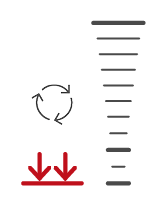 |
The actuator moves in the closed direction until the set torque is reached to ensure reliable closing even in the event of deviations or wear of the seal |
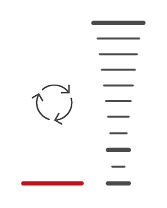 |
The actuator moves to the defined end position, enabling the valve to be shut off with the greatest possible protection for the sealing material |
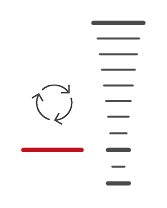 |
The actuator stops shortly before reaching the end position, allowing the flow to be regulated without closing the valve completely. Mainly used for needle valves to protect the needle from deformation |
The actuator moves in the closed direction until the set torque is reached to ensure reliable closing even in the event of deviations or wear of the seal
The actuator moves to the defined end position, enabling the valve to be shut off with the greatest possible protection for the sealing material
The actuator stops shortly before reaching the end position, allowing the flow to be regulated without closing the valve completely. Mainly used for needle valves to protect the needle from deformation
What qualifies the J4M actuator as the best solution for your project?

Flexible voltage range
The internal power supply unit automatically recognises the connected operating voltage and converts it into the required motor voltage of 24V DC.
Operating voltages from 24V to 240V DC or AC (50/60Hz) can be connected in the ‘J4M-S’ voltage range.
Alternatively, the voltage range ‘J4M-B’ is available for applications with 12V DC or AC (50/60Hz).

The DPS uses the integrated Hall sensor to precisely and contactlessly detect the current position of the actuator. Each actuator is already equipped with our DPS and can be configured at any time as an open-close actuator with optional output signal or as a fully-fledged positioner.
Possible Input and output signal:
4-20mA / 0-10V / 1-10V / 0-20mA
Function:
NC / NO / Fail freeze
Open-close control with output signal


Brushless motor
As this motor technology does not require carbon brushes to transfer energy to the rotor, the resulting friction and wear are eliminated.
This makes the brushless motor particularly energy-efficient and durable.
WARRANTY
By using our brushless motors, we can guarantee a service life of 60,000 switching operations or 3 years from the time of delivery.
What is the difference between a brushless motor and a normal DC motor?
In short: Brushless motors are better than brushed motors. Users can benefit from reduced maintenance, improved efficiency and reduced heat and noise. Brushless motors are synchronous machines with one or more permanent magnets. Power tools with brushless motors are now regarded as high-end products.

Status LED
The status LED constantly indicates the current operating status with different colours and flashing cycles.


To prevent damage to the device or valve, the actuators are equipped with electronic torque monitoring, which stops the actuator if it is detected that the motor is consuming more current than permitted. The system interrupts the drive if the breakaway torque is exceeded and relieves the gears by moving them briefly by approx. 2° in the opposite direction. This makes it easier to switch the manual override and remove it from the valve. At the same time, the status LED indicates that the torque protection circuit has been triggered.

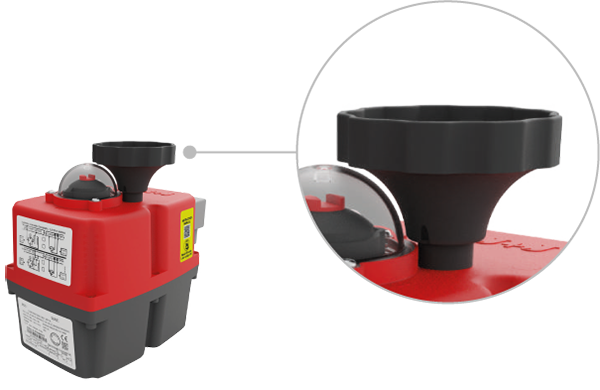
By moving the switch to the manual position, the motor is decoupled and the valve can be operated using the handwheel. After a short time, the motor stops and indicates the activation of the manual override via the status LED. The electrical function can be reactivated by switching to automatic and changing the controlled direction.

The actuator is equipped with relays for open and closed end position feedback.

A thermostat-controlled 3.5 W control room heater automatically keeps the interior temperature above 20 °C (68 °F) to prevent damage caused by condensation in the event of temperature fluctuations. Never switch off the supply voltage after the end of the movement so that the heating is permanently ready for operation.
This value indicates the relationship between the operating time and the minimum pause required during use. The respective time for an operation must always be taken into account. The operating time refers only to the motor running time, so that the power supply may remain permanently active.
Example:
We assume a period of 10 minutes. 75% of this time the motor may operate the valve. This results in:
Maximum motor running time of 7.5 minutes
At least 2.5 minutes pause time
We provide comprehensive support for technical questions and problems relating to our products. We carry out inspections and repairs in our in-house service workshop. As every breakdown can cost money, time and nerves, rapid processing is essential for us.

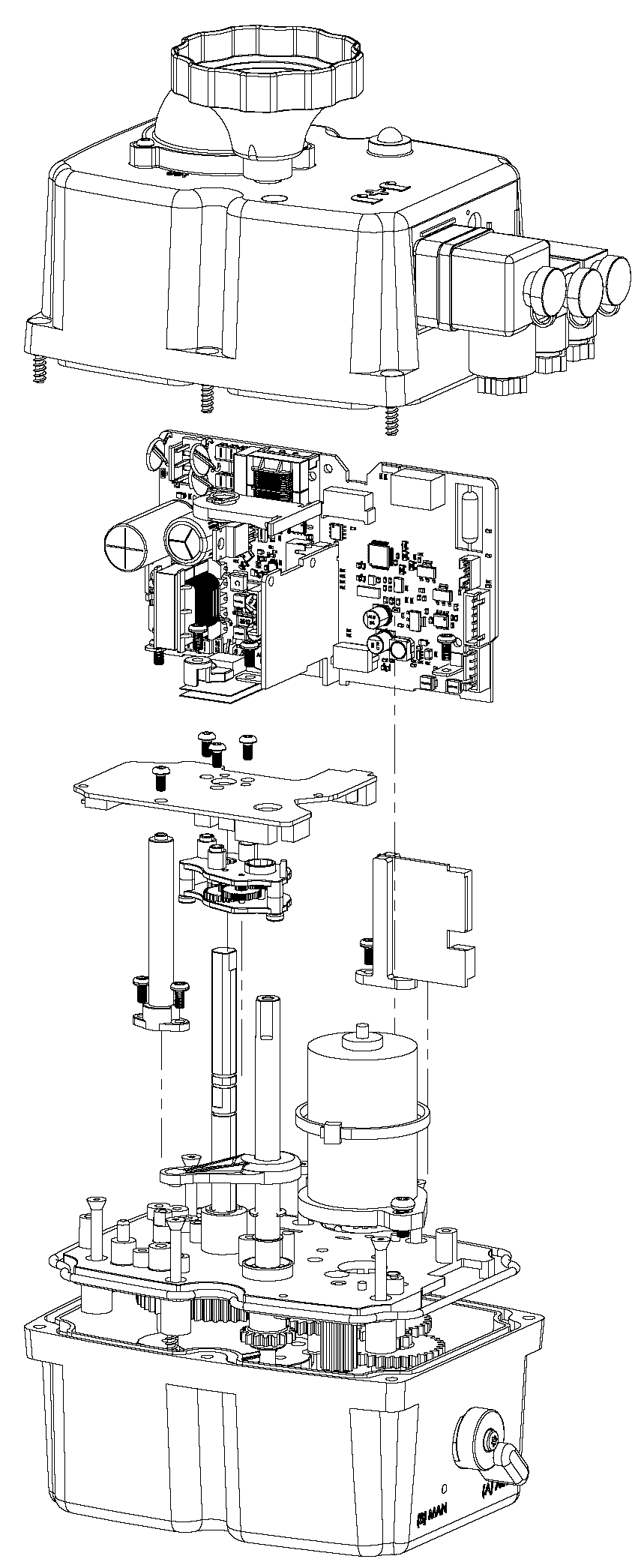
To make replacement as uncomplicated as possible, we use a design with separate circuit boards. All circuit boards that come into contact with the installation and are connected to the plugs of our actuator can be replaced individually.


Model sizes
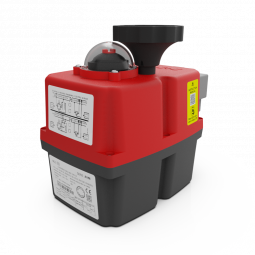
J4M 2
J4M 6
J4M 10
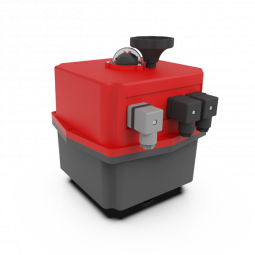
J4M 25
J4M 40

Parts overview

Optional equipment

Factory assembled option

Self-assembly option
 |
ModbusConnection to the universal Modbus protocol for controlling and reading out the actuator. Modbus RTU (RS485)
|
Optional equipment
Factory assembled option
Self-assembly option
Modbus
Connection to the universal Modbus protocol for controlling and reading out the actuator.
Modbus RTU (RS485)
Related J+J products
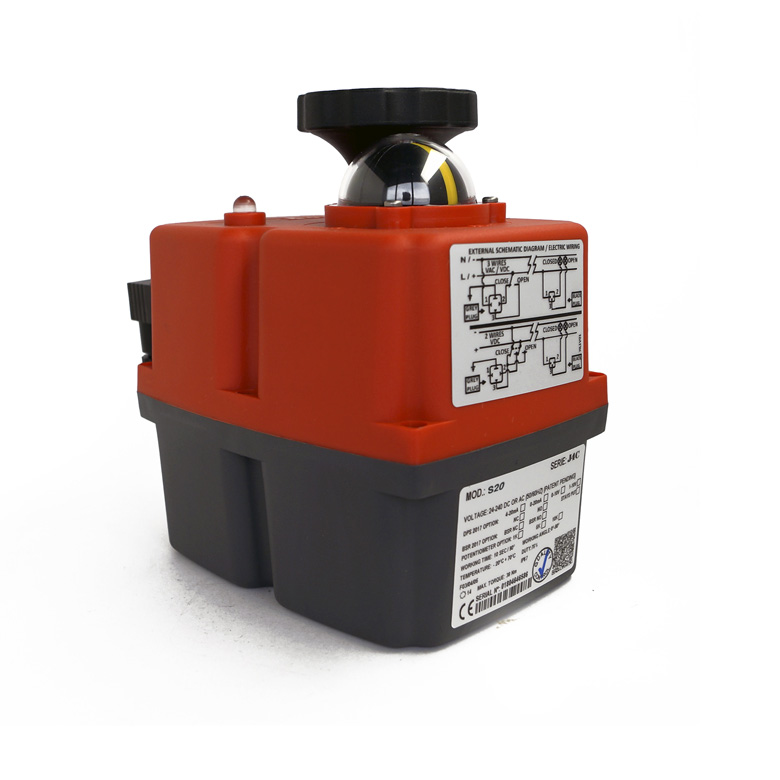
J4C part turn actuator
Our versatile J4C quarter-turn actuators are the perfect solution for automating valves such as ball valves, butterfly valves or plug valves.